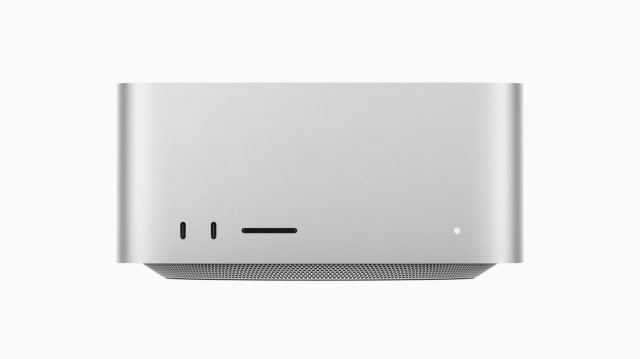
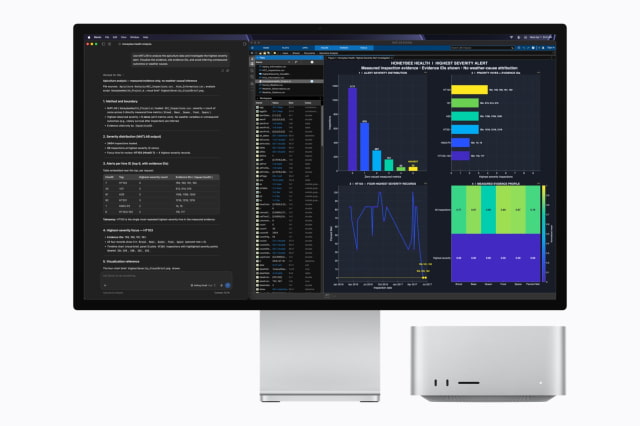
The new Mac Studio with M5 Max and M5 Ultra looks almost identical to the previous generation, but its biggest gains are aimed squarely at AI, graphics, and high-end professional work. Apple has added GPU Neural Accelerators, faster CPU cores, substantially more memory bandwidth, faster PCIe Gen 6 storage, and upgraded wireless connectivity. The 512GB launch-spec memory ceiling is not new; the previous M3 Ultra model also supported it, although Apple stopped offering that configuration later in the product's life as memory shortages constrained high-memory Macs.
For most owners, however, this is not a simple annual upgrade. The M4 Max and M3 Ultra Mac Studio models already offered Thunderbolt 5, extensive pro connectivity, and large memory configurations. The buying decision comes down to whether the new generation's AI and graphics gains are worth the price—or whether a previous-generation model is already more computer than you need.
Quick Answer: New Mac Studio vs Previous Generation
Keep or buy the previous Mac Studio if you want:
Excellent CPU, GPU, and media performance without paying for the latest AI gains
The same compact design, Thunderbolt 5 connectivity, and support for five or eight displays
A potential clearance or refurbished discount as retailers sell remaining stock
Upgrade to Mac Studio with M5 Max if you want:
Much faster GPU-accelerated AI and stronger graphics performance
An 18-core CPU standard, up from 14 cores on the base M4 Max model
Faster PCIe Gen 6 storage, Wi-Fi 7, Bluetooth 6, Thread, and USB-C genlock
Upgrade to Mac Studio with M5 Ultra if you want:
Up to a 36-core CPU, an 80-core GPU, and 1.2TB/s of memory bandwidth
Up to 4.3 times the peak GPU compute for AI and 1.8 times faster graphics than M3 Ultra in Apple's tests
Maximum local-AI, 3D, scientific, VFX, or multi-stream 8K performance
The 7 Biggest Changes in 30 Seconds
GPU Neural Accelerators: Every GPU core in M5 Max and M5 Ultra now includes dedicated hardware for AI matrix operations.
More CPU cores: M5 Max has an 18-core CPU, while M5 Ultra scales to 36 cores.
More memory bandwidth: M5 Max reaches 614GB/s and M5 Ultra reaches 1.2TB/s.
Same launch memory ceiling, much more bandwidth: Both M3 Ultra and M5 Ultra support a 512GB configuration at launch, while bandwidth rises from 819GB/s to 1.2TB/s.
Faster storage: Apple says the new PCIe Gen 6 SSD architecture is up to twice as fast.
New wireless and genlock: Wi-Fi 7, Bluetooth 6, Thread, and genlock over USB-C are new.
Higher Ultra price: M5 Ultra starts at $5,499, $200 above the outgoing model's final Apple price and $1,500 above M3 Ultra's launch price.
M5 Max is the more broadly useful upgrade. Its 18-core CPU has six super cores and 12 performance cores, compared with a 14-core base CPU or 16-core maximum on M4 Max. The GPU still starts at 32 cores and tops out at 40, but each core gains a Neural Accelerator, along with newer shader cores and third-generation hardware-accelerated ray tracing.
Memory capacity remains 36GB standard and 128GB maximum. Bandwidth rises from 410GB/s to 460GB/s on the base configuration, while the top GPU configuration climbs from 546GB/s to 614GB/s.
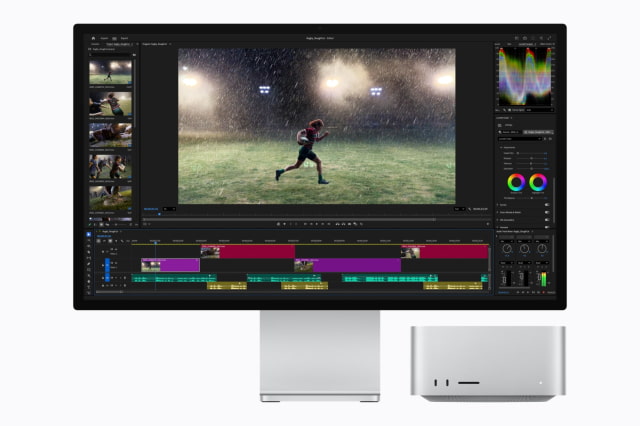
Apple says the M5 Max Mac Studio delivers up to 3.9 times faster LLM prompt processing, 3.5 times faster text-to-image generation, three times faster Magic Mask performance in DaVinci Resolve Studio, and 1.9 times faster DNA basecalling in MinKNOW than M4 Max.
Those are application-specific Apple benchmarks, and the largest gains lean heavily on the new GPU AI hardware. Conventional CPU and GPU work will improve by less. Apple describes the GPU as up to 50 percent faster than the previous generation, while the 18-core CPU should be most noticeable in compilation, rendering, and other multithreaded work.
M5 Ultra vs M3 Ultra: A Much Bigger AI Upgrade
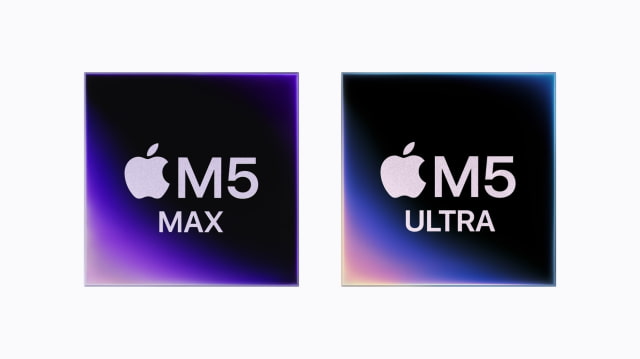
M5 Ultra introduces a quad-die architecture that connects two dual-die M5 Max chips through Apple's next-generation UltraFusion system. The base CPU moves from 28 to 30 cores, while the maximum rises from 32 to 36. The base GPU moves from 60 to 64 cores, though both generations top out at 80 GPU cores.
The difference is what those GPU cores can do. Neural Accelerators arrive on an Ultra chip for the first time, and memory bandwidth increases from 819GB/s to 1.2TB/s. Apple says M5 Ultra delivers up to 1.3 times faster multithreaded CPU performance, 1.8 times faster graphics, and 4.3 times the peak GPU compute for AI versus M3 Ultra.
Apple's workload tests include up to 3.3 times faster CopyCat ML training in Foundry Nuke, four times faster LLM prompt processing in LM Studio, 4.3 times faster text-to-image generation, and 1.7 times faster Redshift rendering than M3 Ultra.
The Media Engine still includes two video decode engines, four video encode engines, and four ProRes encode/decode engines, but Apple says the system can now play up to 33 streams of 8K ProRes 422 video at 30 fps.
AI and Memory Bandwidth: The Real Reason to Buy M5 Ultra
The most consequential memory specification in this update is bandwidth, not the published launch capacity. M3 Ultra and M5 Ultra both support up to 512GB of unified memory, while M5 Ultra raises bandwidth by roughly 50 percent, from 819GB/s to 1.2TB/s.
That does not mean 512GB remained available throughout the M3 Ultra model's entire run. Apple offered it at launch, then removed the 512GB option as the 2026 memory shortage tightened supplies; availability was reduced further before the model was replaced. That is why Apple's archived 2025 Support page now shows a lower ceiling. In the table above, 512GB describes the generation's verified launch capability—not the maximum configuration buyers could still order immediately before the M5 Ultra announcement.
That capacity is not aimed at ordinary productivity. It allows enormous open-weight language models, large scientific datasets, and complex scenes to remain in unified memory instead of relying on cloud compute or shuffling data to slower storage. The M5 Ultra advantage is moving that data faster and processing it with Neural Accelerators in every GPU core. The new model's 512GB configuration will not ship with the rest of the lineup; Apple says it is coming in late October.
M5 Max remains capped at 128GB, just like M4 Max. Its AI advantage comes from the Neural Accelerators and higher bandwidth rather than a larger memory pool.
Mac Studio can also use Thunderbolt 5 and RDMA to cluster multiple systems with a shared memory pool. Apple says a four-system cluster delivers up to three times faster distributed AI inference than one Mac Studio. That is a specialized capability for teams and researchers, not a cost-effective reason for most individuals to buy several machines.
Storage, Connectivity, and Displays
Storage capacities do not change: M5 Max starts at 512GB and reaches 8TB, while M5 Ultra starts at 1TB and reaches 16TB. Apple has moved to a PCIe Gen 6 SSD architecture and says storage performance is up to twice as fast, which can reduce project load times, large file transfers, and model-loading delays.
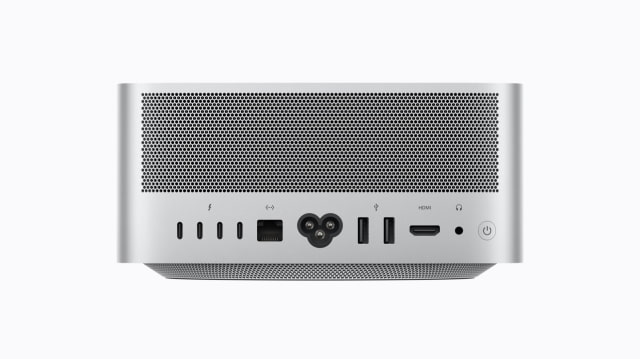
The physical ports are almost unchanged. Every model has four Thunderbolt 5 ports, two USB-A ports, HDMI 2.1, 10Gb Ethernet, and a high-impedance headphone jack on the back. M5 Max has two 10Gb/s USB-C ports and an SDXC slot on the front; M5 Ultra upgrades those two front ports to Thunderbolt 5.
Apple's N1 chip adds Wi-Fi 7, Bluetooth 6, and Thread. USB-C genlock is new, enabling precise synchronization with professional capture hardware, including iPhone 17 Pro.
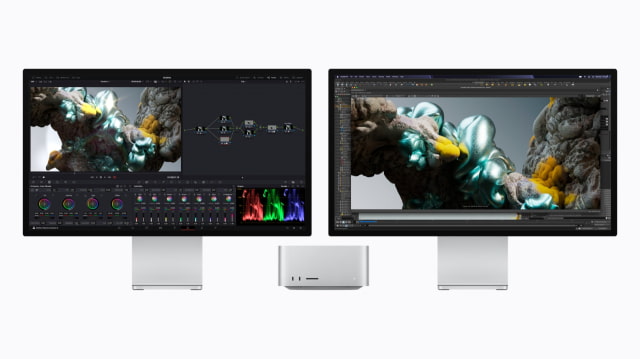
Display counts remain five for Max and eight for Ultra, but supported refresh rates improve. M5 Max can drive four 6K/60Hz or 4K/165Hz displays plus a fifth 5K/60Hz display over HDMI. M5 Ultra can drive up to eight 6K/60Hz or 4K/165Hz displays, or four displays at up to 8K/60Hz, 5K/120Hz, or 4K/240Hz.
Mac Studio Price: Launch Price vs Final Price
Mac Studio pricing also needs historical context. M4 Max launched at $1,999 and M3 Ultra at $3,999 in March 2025. Apple raised Mac prices in June 2026, moving the outgoing Mac Studio lineup to $2,499 for M4 Max and $5,299 for M3 Ultra.
M5 Max starts at $2,499, the same price Apple charged for its predecessor immediately before the update but $500 above the M4 Max launch price. M5 Ultra starts at $5,499, which is $200 above the outgoing model's final price and $1,500 above M3 Ultra's original launch price.
The base memory and storage configurations remain unchanged at 36GB/512GB for Max and 96GB/1TB for Ultra. Buyers are paying for the new chip, faster storage, and connectivity—not more base memory or storage.
The iClarified Price Tracker follows remaining inventory for the M4 Max Mac Studio and M3 Ultra Mac Studio. Both were already difficult to find at third-party retailers on August 25, so any worthwhile clearance stock may sell quickly.
Should You Upgrade to the New Mac Studio?
From Mac Studio with M4 Max: Most owners should keep it. The enclosure, port selection, memory ceiling, storage capacities, and display count are largely unchanged. Upgrade if GPU-accelerated AI is central to your work, you need the 18-core CPU, or Apple's cited gains in DaVinci Resolve, image generation, LLM inference, or similar applications would save meaningful production time.
From Mac Studio with M3 Ultra: Upgrade only for a workload that can use the new hardware. The strongest reasons are much higher AI compute, faster graphics, the newer CPU, and 1.2TB/s bandwidth—not a higher launch-spec memory ceiling, because both generations support 512GB. If your current projects finish on schedule, M3 Ultra remains extremely capable.
From an M1 or M2 Max/Ultra Mac Studio: This is a much more substantial jump. Apple cites large gains over M1 Max and M1 Ultra, and the move to Thunderbolt 5, hardware ray tracing, AV1 decode, faster storage, and newer wireless standards adds practical improvements beyond raw speed.
For a first-time Mac Studio buyer: M5 Max is the sensible choice for most professional users. M5 Ultra is justified when you need more than 128GB of unified memory, maximum GPU and media performance, eight displays, or the ability to run very large AI models locally. If you are unsure whether you need Ultra, you probably do not.
The new Mac Studio is available to preorder now and begins arriving September 22. Configurations with 512GB of unified memory arrive in late October.
Track Mac Studio Prices and Availability
Before ordering, check the iClarified Mac Price Tracker for current Mac pricing and retailer availability. The tracker also follows remaining inventory for the M4 Max Mac Studio and M3 Ultra Mac Studio, making it easier to compare a clearance deal with the new models.
Get the iClarified Daily Newsletter
Apple news, rumors, tutorials, price drop alerts, in your inbox every evening, free.
Unsubscribe at any time.
Success!
You have been subscribed.
Add Comment
Would you like to be notified when someone replies or adds a new comment?
Yes (All Threads)
Yes (This Thread Only)
No
Notifications
Would you like to be notified when we post a new Apple news article or tutorial?




![Apple-LG Home Accessories Could Offer Dynamic Island Proximity Controls [Leak]](/images/news/102711/102711/102711-160.jpg "Apple-LG Home Accessories Could Offer Dynamic Island Proximity Controls [Leak]")




![How To Force Restart iPhone [Video]](/images/tutorials/95012/95012/95012-160.jpg "How To Force Restart iPhone [Video]")
![How To Turn Off iPhone [Video]](/images/tutorials/94999/94999/94999-160.jpg "How To Turn Off iPhone [Video]")
![How To Back Up Your iPhone to an External Drive on Mac [Video]](/images/tutorials/72786/72786/72786-160.jpg "How To Back Up Your iPhone to an External Drive on Mac [Video]")





![Mac mini Drops to $779.99 for Prime Big Deal Days [Deal]](/images/news/102624/102624/102624-160.jpg "Mac mini Drops to $779.99 for Prime Big Deal Days [Deal]")