Chrome has set new browser performance records on a MacBook Pro powered by Apple's M5 chip, according to Google, posting its highest-ever scores on both the Speedometer 3.1 and JetStream 3 benchmarks.
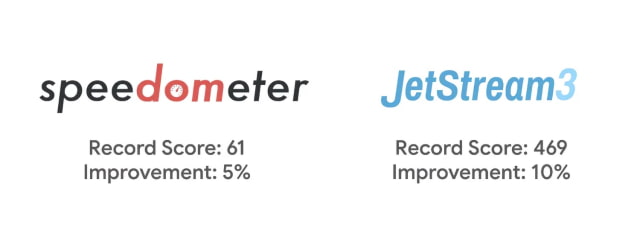
Chrome scored 61 on Speedometer, a 5% improvement over the past year, and 469 on JetStream 3, up 10% since the start of 2026. Google says the results give Chrome a dual record across all browsers, ahead of every other Mac browser, including Safari.
The performance gains come from optimizations across Chrome's JavaScript engine, WebAssembly support, and Blink rendering engine. On the JavaScript side, the team introduced "fast path" inlining for common operations, allowing the engine to skip unnecessary execution steps. Some of the largest gains came from async operations such as microtask dispatch and await resolution. Similar techniques were also applied to sorting and string comparisons. The company also adjusted how Chrome decides when functions should be optimized, particularly for async and generator functions, while reducing some internal memory allocations. Chrome's BigInt implementation also received improvements in division, canonicalisation, and data structure allocation.
WebAssembly workloads saw improvements to SIMD code generation and register allocation, helping AI, cryptography, and interpreter use cases. Chrome also reduced overhead for JavaScript-to-WebAssembly calls by eliminating redundant type conversions and loads inside loops.
Rendering engine updates focused on style computation, DOM operations, and text processing. A unified querySelector() cache reduces redundant DOM lookups, while SIMD operations speed up string copying and creation during HTML parsing. Chrome also expanded caching for dataURI resources, reduced style recalculation delays for transitions, and simplified CSS selector caching and matching. Additional work addressed font fallback issues, reduced glyph-width calculation overhead, introduced an SVG processing cache, and streamlined DOM storage structures.
The tests were conducted on a MacBook Pro with Apple's M5 chip running macOS 26.0.1, though Google did not specify whether the system used an M5, M5 Pro, or M5 Max configuration.
Google says the benchmark improvements translate into a "meaningfully faster" day-to-day browsing experience, with additional JavaScript optimizations planned.
Google's benchmark scores are self-reported. Detailed results are available on the Chromium Blog.
Get the iClarified Daily Newsletter
Apple news, rumors, tutorials, price drop alerts, in your inbox every evening, free.
Unsubscribe at any time.
Success!
You have been subscribed.
Add Comment
Would you like to be notified when someone replies or adds a new comment?
Yes (All Threads)
Yes (This Thread Only)
No
Notifications
Would you like to be notified when we post a new Apple news article or tutorial?




![Apple Releases iOS 27.2 RC and iPadOS 27.2 RC to Developers [Download]](/images/news/102906/102906/102906-160.jpg "Apple Releases iOS 27.2 RC and iPadOS 27.2 RC to Developers [Download]")
![Apple Releases macOS 27.2 Golden Gate RC to Developers [Download]](/images/news/102909/102909/102909-160.jpg "Apple Releases macOS 27.2 Golden Gate RC to Developers [Download]")
![Apple Seeds watchOS 27.2, tvOS 27.2, and visionOS 27.2 Release Candidates [Download]](/images/news/102912/102912/102912-160.jpg "Apple Seeds watchOS 27.2, tvOS 27.2, and visionOS 27.2 Release Candidates [Download]")
![Apple Announces 'Pro and Tell' Event for October 28 [Video]](/images/news/102903/102903/102903-160.jpg "Apple Announces 'Pro and Tell' Event for October 28 [Video]")
![Apple Plans 9-Inch HomeView With Robotic Arm for 2027 or 2028 [Gurman]](/images/news/102885/102885/102885-160.jpg "Apple Plans 9-Inch HomeView With Robotic Arm for 2027 or 2028 [Gurman]")

![How To Install Homebrew on Mac [Video]](/images/tutorials/83695/83695/83695-160.jpg "How To Install Homebrew on Mac [Video]")
![How To Back Up Your iPhone to an External Drive on Mac [Video]](/images/tutorials/72786/72786/72786-160.jpg "How To Back Up Your iPhone to an External Drive on Mac [Video]")


![16-Inch MacBook Pro With M5 Max Drops to $3,499 ($900 Off), Lowest Price We've Seen [Deal]](/images/news/102900/102900/102900-160.jpg "16-Inch MacBook Pro With M5 Max Drops to $3,499 ($900 Off), Lowest Price We've Seen [Deal]")
![Mac Studio With M5 Max Is $200 Off, Lowest Price We've Seen [Deal]](/images/news/102897/102897/102897-160.jpg "Mac Studio With M5 Max Is $200 Off, Lowest Price We've Seen [Deal]")
![14-Inch MacBook Pro With M5 Pro Drops to $2,069.10 ($429 Off) [Deal]](/images/news/102879/102879/102879-160.jpg "14-Inch MacBook Pro With M5 Pro Drops to $2,069.10 ($429 Off) [Deal]")
![Apple HomeView and New Apple TV 4K Get First Pre-Order Discount on Amazon [Deal]](/images/news/102867/102867/102867-160.jpg "Apple HomeView and New Apple TV 4K Get First Pre-Order Discount on Amazon [Deal]")
![14-Inch MacBook Pro With M5 Max Drops to $3,299 ($800 Off) [Deal]](/images/news/102828/102828/102828-160.jpg "14-Inch MacBook Pro With M5 Max Drops to $3,299 ($800 Off) [Deal]")
