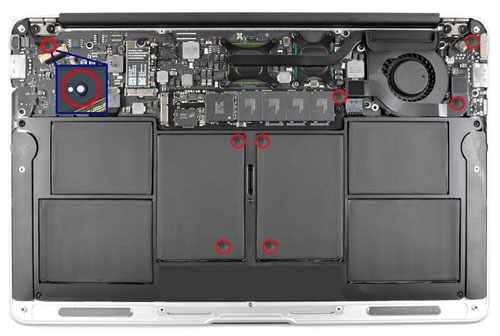
Apple has put a record 8 liquid contact indicators in its new MacBook Air, according to HardMac and Kodawarisan.
Apple began including these LCIs in its iPods and iPhones in 2007 and added them to its MacBook and MacBook Pro notebooks in 2008. Since then the indicators have been used to deny warranty service to customers.
Unfortunately, the sensors are not 100% accurate and have caused Apple to refuse service to customers with legitimate issues. Customers have found that the sensors can be tripped by humidity and temperature fluctuations.
Apple, of course, says the sensors "are designed not to be triggered by humidity and temperature changes that are within the product's environmental requirements described by Apple."
In April, a class action lawsuit was filed against Apple alleging that the company knowingly denies warranty service based on unreliable LCIs.
Apple is aware that external Liquid Submersion Indicators cannot be relied upon to establish with any reasonable degree of certainty that a Class Device has even been exposed to (much less damaged by) liquid. Plaintiff is informed and believes that independent testing has demonstrated that Liquid Submersion Indicators can be triggered by, among other things, cold weather and humidity that are within Apple's technical specifications for the Class Devices.
[via HardMac]
Get the iClarified Daily Newsletter
Apple news, rumors, tutorials, price drop alerts, in your inbox every evening, free.
Unsubscribe at any time.
Success!
You have been subscribed.
Add Comment
Would you like to be notified when someone replies or adds a new comment?
Yes (All Threads)
Yes (This Thread Only)
No
Notifications
Would you like to be notified when we post a new Apple news article or tutorial?
Yes
No
Comments (3)
Comments are closed for this article.
0
DigiHead - November 3, 2010 at 11:04am
and so? each and every nokia or any other brands have these things inside and use them to refuse warranty repair. 8 indicators are good - the more you have the precisely you can evaluate level of damage or decide is there any.
0
thunderbucket - November 3, 2010 at 10:42am
8 CLI's? So why are there 9 circles on the picture?
0
Anonymous - November 3, 2010 at 11:40am
One of them is an enlargement of a liquid contact indicators.









![How To Change Wallpaper on Mac [Video]](/images/tutorials/90512/90512/90512-160.jpg "How To Change Wallpaper on Mac [Video]")
![How To Turn Off Always On Display on iPhone [Video]](/images/tutorials/87524/87524/87524-160.jpg "How To Turn Off Always On Display on iPhone [Video]")





![16-Inch M5 Max MacBook Pro Drops $900 to New Low of $3,499 [Deal]](/images/news/102438/102438/102438-160.jpg "16-Inch M5 Max MacBook Pro Drops $900 to New Low of $3,499 [Deal]")
![Magic Keyboard for iPad Air Drops to $200 on Amazon [Deal]](/images/news/102402/102402/102402-160.jpg "Magic Keyboard for iPad Air Drops to $200 on Amazon [Deal]")
