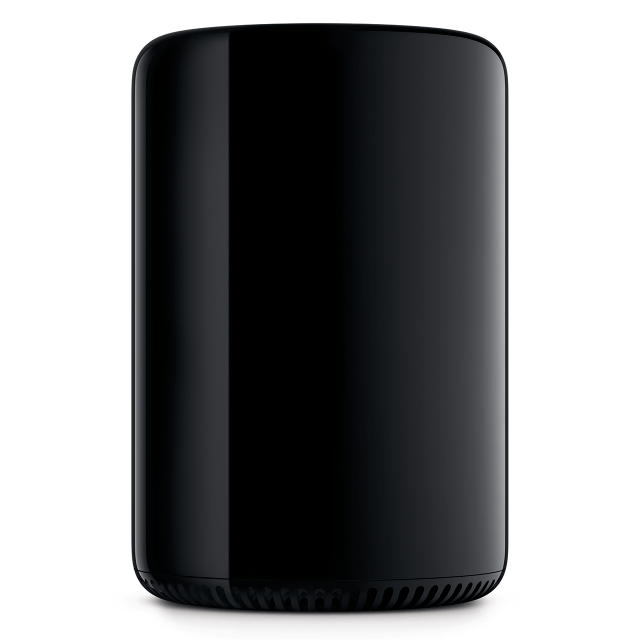
Apple has released an environmental report on the new Mac Pro detailing the performance of its new desktop as it relates to climate change, energy efficiency, material efficiency, and restricted substances.
Notably, the 2013 Mac Pro consumes 68% less power in idle mode than the previous generation. Its packaging uses corrugated cardboard made with a minimum of 33 percent post-consumer recycled content and consumes 82 percent less volume than the previous-generation Mac Pro.
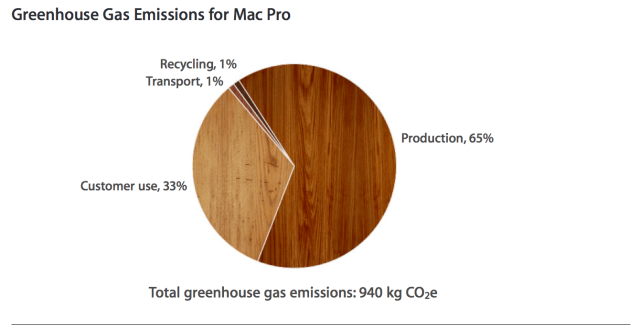
Climate Change Greenhouse gas emissions have an impact on the planet’s balance of land, ocean, and air temperatures. Most of Apple’s corporate greenhouse gas emissions come from the production, transport, use, and recycling of its products. Apple seeks to minimize greenhouse gas emissions by setting stringent design-related goals for material and energy efficiency. The chart below provides the estimated greenhouse gas emissions for Mac Pro over its life cycle.
Energy Efficiency Because one of the largest portions of product-related greenhouse gas emissions results from actual use, energy efficiency is a key part of each product’s design. Apple products use power-efficient components and software that can intelligently power them down during periods of inactivity. The result is that Mac Pro is energy efficient right out of the box.
Mac Pro outperforms the stringent requirements of the ENERGY STAR Program Requirements for Computers Version 6.0, utilizing less than half the allowable energy limit. In addition, Mac Pro consumes 68 percent less power in idle mode than the previous-generation Mac Pro.
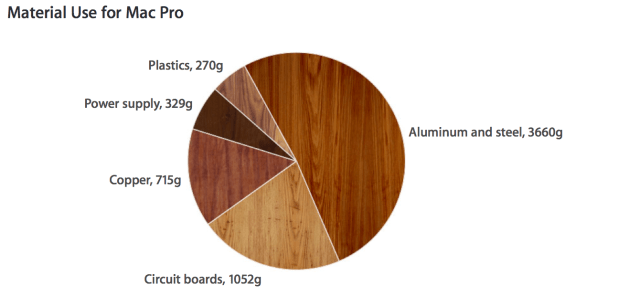
Material Efficiency Apple’s ultracompact product and packaging designs lead the industry in material efficiency. Reducing the material footprint of a product helps maximize shipping efficiency. It also helps reduce energy consumed during production as well as material waste generated at the end of the product’s life. The enclosure and thermal core of Mac Pro is made of aluminum and copper, materials that are highly desired by recyclers. The chart below details the materials used in this model.
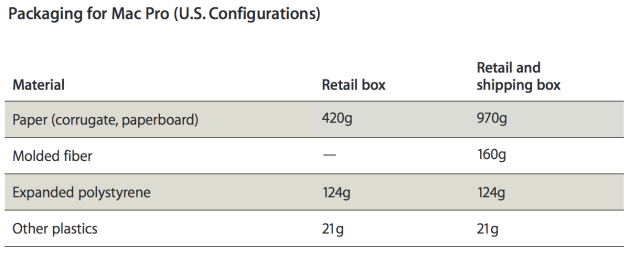
Packaging The packaging for Mac Pro uses corrugated cardboard made with a minimum of 33 percent post-consumer recycled content. In addition, its packaging is extremely material efficient, consuming 82 percent less volume than the previous-generation Mac Pro. The following table details the materials used in its packaging.
Restricted Substances Apple has long taken a leadership role in restricting harmful substances from its products and packaging. As part of this strategy, all Apple products comply with the strict European Directive on the Restriction of the Use of Certain Hazardous Substances in Electrical and Electronic Equipment, also known as the RoHS Directive. Examples of materials restricted by RoHS include lead, mercury, cadmium, hexavalent chromium, and the brominated flame retardants (BFRs) PBB and PBDE. Mac Pro goes even further than the requirements of the RoHS Directive by incorporating the following more aggressive restrictions: • BFR-free • PVC-free internal cables • PVC-free AC power cord available in all regions except India and South Korea
Recycling Through ultra-efficient design and the use of highly recyclable materials, Apple has minimized material waste at the product’s end of life. In addition, Apple offers and participates in various product take-back and recycling programs in 95 percent of the regions where Apple products are sold. All products are processed in the country or region in which they are collected. For more information on how to take advantage of these programs, visit www.apple.com/recycling









![How To Change Wallpaper on Mac [Video]](/images/tutorials/90512/90512/90512-160.jpg "How To Change Wallpaper on Mac [Video]")
![How To Turn Off Always On Display on iPhone [Video]](/images/tutorials/87524/87524/87524-160.jpg "How To Turn Off Always On Display on iPhone [Video]")





![16-Inch M5 Max MacBook Pro Drops $900 to New Low of $3,499 [Deal]](/images/news/102438/102438/102438-160.jpg "16-Inch M5 Max MacBook Pro Drops $900 to New Low of $3,499 [Deal]")
![Magic Keyboard for iPad Air Drops to $200 on Amazon [Deal]](/images/news/102402/102402/102402-160.jpg "Magic Keyboard for iPad Air Drops to $200 on Amazon [Deal]")
