

GPT-6 Sol and Luna cut API prices in half while promising fewer factual mistakes and stronger coding performance, OpenAI says.
Compared with the promotional prices of the GPT-5.6 models, GPT-6 Sol costs $2 per million input tokens and $10 per million output tokens, down from $4 and $20. GPT-6 Luna costs $0.10 and $0.50, down from $0.20 and $1.20.
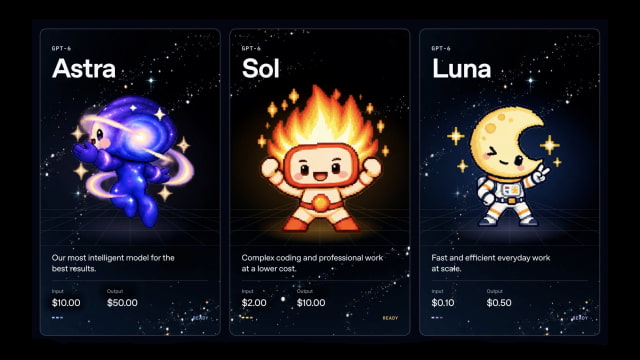
Both models are available starting today in ChatGPT Work and Codex for Plus, Pro, Business, Enterprise and Edu users. Free and Go users can access Luna in the desktop app. The API model IDs are gpt-6-sol and gpt-6-luna. Neither is yet available in Chat, and the rollout is continuing gradually through the day.
Sol is aimed at complex coding and professional work, while Luna targets focused, high-volume tasks. In OpenAI's internal factuality evaluation of conversations where users had flagged mistakes, Sol made about half as many errors as GPT-5.6 Sol and approached Astra-level reliability at lower cost. Luna at higher effort matched GPT-5.6 Sol at about a hundredth of its cost. The company cautions that these error-inducing conversations are not representative of typical usage, where factual errors are rarer.
On FrontierCode, Sol improved substantially over GPT-5.6 Sol and matched Claude Fable 5.1 at xhigh effort at lower cost. On DeepSWE v1.1, Sol at max effort scored 68.8%, compared with 69.9% for Claude Fable 5 at xhigh effort, at approximately 80% lower cost per task. Luna at max effort scored 66.6%, comparable to Claude Opus 5 and Fable 5 at medium effort, with per-task costs 93% and 96% lower, respectively.
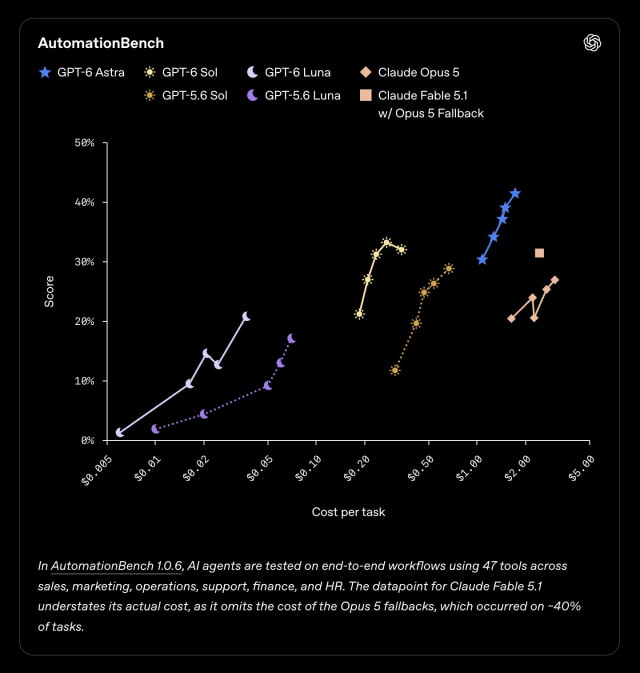
On AutomationBench, Sol at xhigh effort scored 33.2% at $0.27 per task. At max effort, it scored 56.4% on Agents' Last Exam, above Claude Opus 5's highest result in the evaluation, with a per-task cost 60% lower. For computer use, Sol at xhigh effort scored 60.5% on OSWorld 2.0 offline, compared with 60.3% for Opus 5 at medium effort, at approximately 80% lower cost per task. Luna at max effort exceeded GPT-5.6 Sol at medium effort at a tenth of its cost. The Opus comparisons use Claude Opus 5; Anthropic released Claude Opus 5.5 earlier today with lower running costs, faster output, and higher intelligence.
The company says both models produce slightly shorter answers with less jargon, especially in technical and coding conversations. GPT-6 also offers a 90% discount on cached input-token reads, while changes to reasoning effort or tool availability now preserve earlier context for cache reuse. A dashboard tracks the cached share over time, with diagnostics for missed opportunities. In a separate internal alignment test, Sol and Luna showed lower rates of misleading claims about their coding work than their GPT-5.6 counterparts. The test deliberately uses challenging cases and does not measure failure rates in typical use.
The pair arrive weeks after GPT-6 Astra debuted as the flagship earlier this month. They follow GPT-5.6 Sol and Luna, and the announcement makes no mention of a Terra equivalent.


![Beats 360 Headphones Debut With Swappable Cushions, IPX4 Rating for $349.99 [Video]](/images/news/102342/102342/102342-160.jpg "Beats 360 Headphones Debut With Swappable Cushions, IPX4 Rating for $349.99 [Video]")












![Apple Studio Display XDR Hits All-Time Low of $2,969.99 ($329 Off) [Deal]](/images/news/101976/101976/101976-160.jpg "Apple Studio Display XDR Hits All-Time Low of $2,969.99 ($329 Off) [Deal]")
