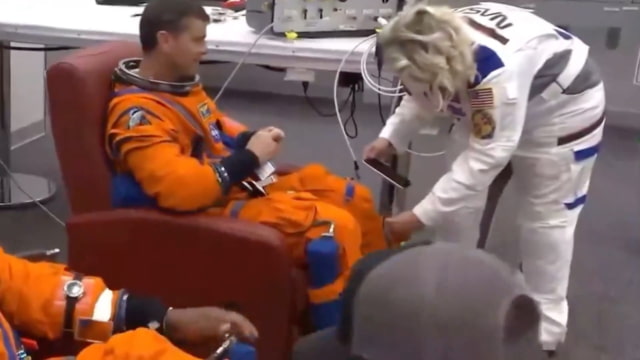
NASA's Artemis II crew members have been spotted with a familiar piece of tech floating in the cockpit: the silver iPhone 17 Pro Max. This mission, the first crewed journey toward the moon in over half a century, has integrated Apple's latest flagship as an additional tool for the crew to capture high-resolution imagery and video of their historic voyage.
About four hours into the mission, cameras overlooking the cockpit of the Orion spacecraft captured a silver iPhone drifting through the air. It left the hands of Jeremy Hansen, passed over the heads of Reid Wiseman and Victor Glover, and was eventually retrieved by Christina Koch. While the astronauts still carry professional-grade Nikon D5s and GoPros, they are also using the iPhone 17 Pro Max for its advanced optics and portability. NASA Administrator Jared Isaacman said the agency had to challenge long-standing qualification processes to get this modern hardware cleared for flight on an expedited timeline.
NASA astronauts are given silver iPhone 17 Pro Max for the Artemis II flight!
The same phone we use could be used to take pictures of the Moon
Look at how it's floating in zero gravity, this could be the ultimate Shot on iPhone commercial 😭 pic.twitter.com/gQzrR6miDP
The astronauts are already putting the phone's hardware to work, specifically using the 8x optical zoom to photograph the upper stage of the rocket that propelled them into space. They also used the device to film the Orion capsule's movements during docking demonstrations, capturing the action in 4K Dolby Vision. Even though these are the same phones you can buy at a retail store, they have some major restrictions in orbit. NASA confirmed the devices cannot connect to the internet or use Bluetooth to prevent any interference with the spacecraft's sensitive communication arrays.
Getting a glass-heavy device like an iPhone through safety panels is a complex task. In a weightless, perfectly sealed capsule, the risk of glass shattering is a serious concern since those tiny shards wouldn't fall to the floor. The Ceramic Shield 2 front cover could have helped in the qualification process, given its improved durability. To keep the phones from simply drifting away when not in use, the crew uses Velcro to mount them to the interior walls, or they simply zip them into the leg pockets of their flight suits.
This milestone for NASA actually coincides with Apple's 50th anniversary and marks the first time an iPhone has been fully qualified for extended NASA use in deep space. While iPhones have flown on private missions before, the Artemis II integration is a sign that NASA is getting more comfortable using consumer tech for high-stakes research. Apple said it wasn't directly involved in the testing process, but the hardware is now officially part of the toolkit for the next generation of lunar explorers.
Get the iClarified Daily Newsletter
Apple news, rumors, tutorials, price drop alerts, in your inbox every evening, free.
Unsubscribe at any time.
Success!
You have been subscribed.
Add Comment
Would you like to be notified when someone replies or adds a new comment?
Yes (All Threads)
Yes (This Thread Only)
No
Notifications
Would you like to be notified when we post a new Apple news article or tutorial?
Yes
No
Comments (1)
Comments are closed for this article.
0
max1987martin - April 7, 2026 at 6:35am
Yehh, NASA Administrator Jared Isaacman said the agency had to challenge long-standing qualification processes to get this modern hardware cleared for flight on an expedited timeline.





![Apple Targets October 13 for Smart Home Hub, New HomePod mini and Apple TV [Gurman]](/images/news/102501/102501/102501-160.jpg "Apple Targets October 13 for Smart Home Hub, New HomePod mini and Apple TV [Gurman]")


![How To Find Your iPhone IMEI Number [Video]](/images/tutorials/83557/83557/83557-160.jpg "How To Find Your iPhone IMEI Number [Video]")



![16-Inch M5 Max MacBook Pro Drops $900 to New Low of $3,499 [Deal]](/images/news/102438/102438/102438-160.jpg "16-Inch M5 Max MacBook Pro Drops $900 to New Low of $3,499 [Deal]")
![Magic Keyboard for iPad Air Drops to $200 on Amazon [Deal]](/images/news/102402/102402/102402-160.jpg "Magic Keyboard for iPad Air Drops to $200 on Amazon [Deal]")
![13-Inch M5 MacBook Air With 1TB Drops to $1,449 on Amazon [Deal]](/images/news/102345/102345/102345-160.jpg "13-Inch M5 MacBook Air With 1TB Drops to $1,449 on Amazon [Deal]")