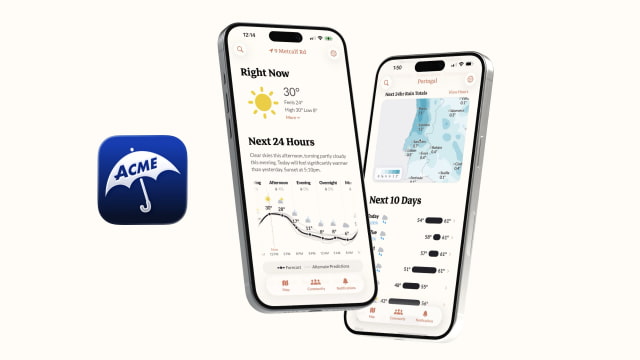
The team behind the Dark Sky weather app has returned to the App Store with a new application called Acme Weather. The launch comes several years after Apple acquired the original platform in 2020 and later shut it down to integrate its hyperlocal technology directly into iOS.
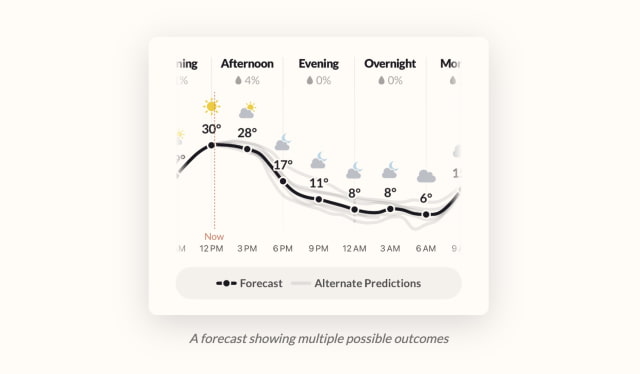
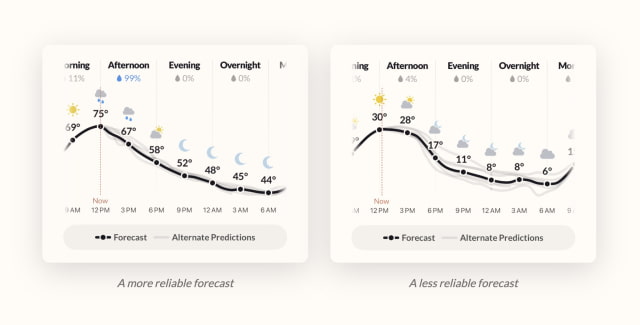
Developer Adam Grossman explained that the team left Apple to build a weather tool that better addresses forecast uncertainty. Recognizing that forecasts are inherently uncertain, Acme avoids presenting a single definitive prediction. Instead, the app displays what it calls Alternate Predictions. This homegrown forecast model, which the developers say improves upon their earlier Dark Sky system, generates a spread of potential outcomes based on numerical weather prediction models, satellite data, ground station observations, and radar data. A tight grouping of forecast lines indicates high confidence, while a wide spread signals that conditions may change rapidly, giving users a quick sense of reliability.
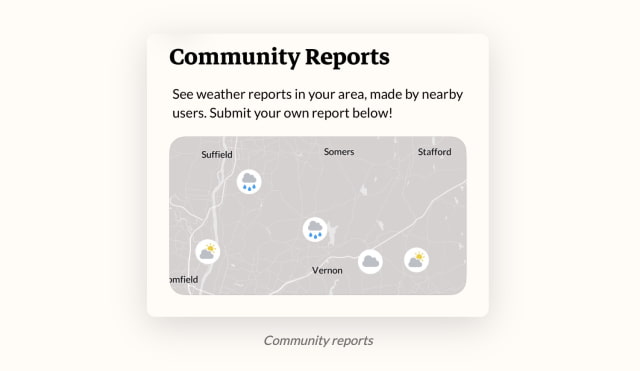
To improve real-time tracking during fast-moving storms, the developers introduced community reporting. Users can submit the exact weather conditions outside their window using specific icons or emojis. These real-time reports populate the map instantly, providing localized reports when radar may miss light precipitation or shifting temperatures. The app also highlights recent nearby reports directly in the interface.
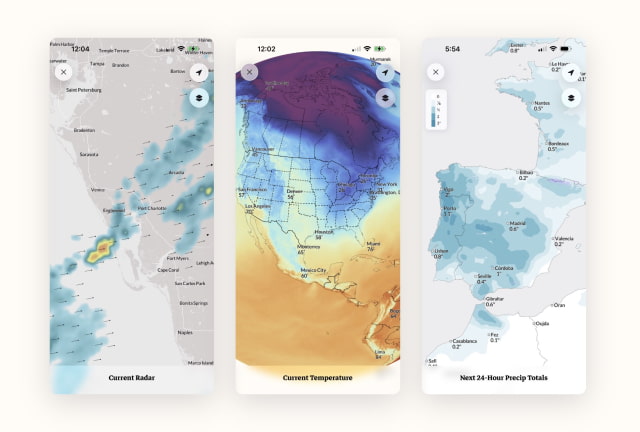
Maps are deeply integrated into the core experience. Acme includes detailed layers for radar, lightning strikes, rain and snow accumulation, wind, and air quality. Rather than hiding these visuals in a separate tab, the most relevant maps appear directly inside the main forecast view to provide immediate context about the size and trajectory of an incoming storm.
Notifications are also a major focus, reviving the down-to-the-minute rain alerts that originally made Dark Sky so popular. Users can enable government severe weather alerts, nearby lightning warnings, and daily summaries. The app supports highly customizable alerts as well, letting individuals set specific triggers for conditions like a high UV index or impending heavy snowfall. An experimental section called Acme Labs brings additional meteorological trackers to the interface, including alerts for nearby rainbows and predictions for highly visible sunsets.
Privacy is also a focus of the new service. The developers say Acme collects only the data necessary to generate forecasts. The company does not store location history, sell user data, or use third-party tracking analytics.
Acme Weather is available to download now on the App Store. The service is free to try for two weeks, after which it requires a $25 per year subscription. An Android version is also planned for the future.






![How To Change Wallpaper on Mac [Video]](/images/tutorials/90512/90512/90512-160.jpg "How To Change Wallpaper on Mac [Video]")
![How To Turn Off Always On Display on iPhone [Video]](/images/tutorials/87524/87524/87524-160.jpg "How To Turn Off Always On Display on iPhone [Video]")


![16-Inch M5 Max MacBook Pro Drops $900 to New Low of $3,499 [Deal]](/images/news/102438/102438/102438-160.jpg "16-Inch M5 Max MacBook Pro Drops $900 to New Low of $3,499 [Deal]")
![Magic Keyboard for iPad Air Drops to $200 on Amazon [Deal]](/images/news/102402/102402/102402-160.jpg "Magic Keyboard for iPad Air Drops to $200 on Amazon [Deal]")
![13-Inch M5 MacBook Air With 1TB Drops to $1,449 on Amazon [Deal]](/images/news/102345/102345/102345-160.jpg "13-Inch M5 MacBook Air With 1TB Drops to $1,449 on Amazon [Deal]")
