Anthropic has launched Claude Opus 4.7, its latest flagship model that brings a notable improvement in advanced software engineering and upgraded high-resolution vision. Coming two months after the release of Claude Sonnet 4.6, the new model builds on that foundation with stronger performance on complex, long-running tasks that previously required closer supervision.
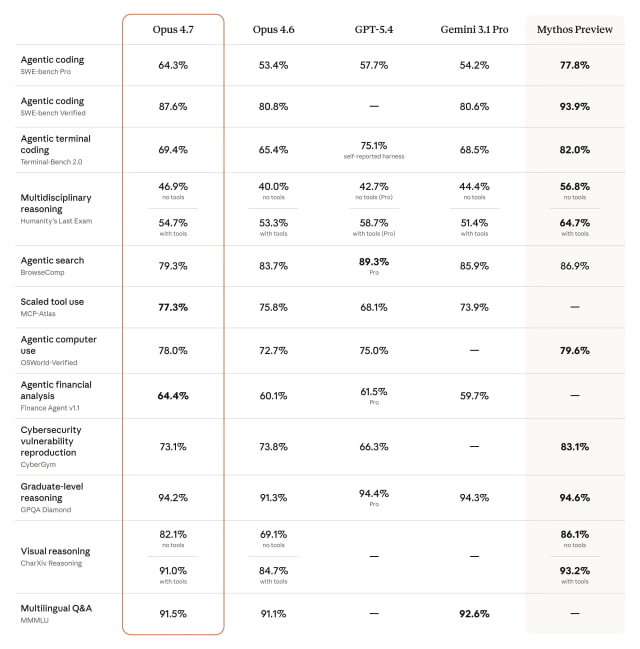
The big story here is software engineering. Benchmark data shows that Opus 4.7 achieved a 64.3% score on the SWE-bench Pro test, which measures how well an AI can fix real-world GitHub issues. That is a clear jump from the 53.4% seen in the previous 4.6 version and places it ahead of OpenAI's GPT-5.4, which scored 57.7%. For developers on the Mac, the model is well-suited for use with Apple's Xcode 26.3, which introduced support for autonomous AI agents that can handle longer, multi-step workflows.
The vision side of the model has also been significantly upgraded. Opus 4.7 can now process images up to 2,576 pixels on the long edge, which works out to about 3.75 megapixels. That is more than triple the resolution limit of previous Claude models. This added detail supports use cases like computer control on macOS, where an AI agent needs to read dense text from screenshots or navigate complex diagrams and user interfaces with precision.
Safety and security remain a major focus following the introduction of Project Glasswing, which highlights both the risks and benefits of using AI models in cybersecurity. Opus 4.7 is the first model in this rollout to include safeguards designed to detect and block high-risk or prohibited cybersecurity requests. For legitimate security researchers, Anthropic is launching a Cyber Verification Program to allow access for vulnerability testing and red-teaming.
Anthropic is also giving users more control over how the model thinks. A new "xhigh" effort level has been added between the high and max settings, letting you fine-tune the balance between reasoning depth and latency. In the Claude Code desktop environment, a new /ultrareview command can now be used to flag bugs and design flaws that a standard code review might miss.
The model also introduces improvements to memory and real-world task performance. Opus 4.7 is better at using file system-based memory, allowing it to retain important context across long, multi-session workflows. Anthropic says it also delivers stronger results in finance-related evaluations and broader knowledge work benchmarks, producing more rigorous analyses and higher-quality outputs across complex tasks.
There is a small catch for those migrating from Opus 4.6. This new version uses a more literal instruction-following style, which means prompts that were written to be interpreted loosely may need to be re-tuned. It also features an updated tokenizer that improves text processing but can increase token usage for some inputs by roughly 1.0 to 1.35 times, depending on the content.
Claude Opus 4.7 is generally available today via the Claude API and through cloud providers like Amazon Bedrock, Google Cloud Vertex AI, and Microsoft Foundry. Pricing remains the same as the previous version at $5 per million input tokens and $25 per million output tokens.
Get the iClarified Daily Newsletter
Apple news, rumors, tutorials, price drop alerts, in your inbox every evening, free.
Unsubscribe at any time.
Success!
You have been subscribed.
Add Comment
Would you like to be notified when someone replies or adds a new comment?
Yes (All Threads)
Yes (This Thread Only)
No
Notifications
Would you like to be notified when we post a new Apple news article or tutorial?







![Apple Targets October 13 for Smart Home Hub, New HomePod mini and Apple TV [Gurman]](/images/news/102501/102501/102501-160.jpg "Apple Targets October 13 for Smart Home Hub, New HomePod mini and Apple TV [Gurman]")



![How To Find Your iPhone IMEI Number [Video]](/images/tutorials/83557/83557/83557-160.jpg "How To Find Your iPhone IMEI Number [Video]")



![16-Inch M5 Max MacBook Pro Drops $900 to New Low of $3,499 [Deal]](/images/news/102438/102438/102438-160.jpg "16-Inch M5 Max MacBook Pro Drops $900 to New Low of $3,499 [Deal]")
![Magic Keyboard for iPad Air Drops to $200 on Amazon [Deal]](/images/news/102402/102402/102402-160.jpg "Magic Keyboard for iPad Air Drops to $200 on Amazon [Deal]")
![13-Inch M5 MacBook Air With 1TB Drops to $1,449 on Amazon [Deal]](/images/news/102345/102345/102345-160.jpg "13-Inch M5 MacBook Air With 1TB Drops to $1,449 on Amazon [Deal]")