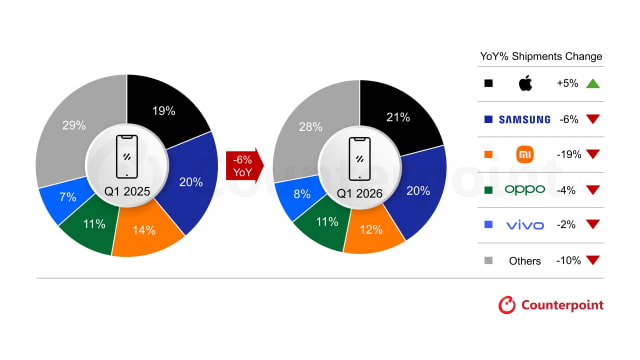
Apple officially led global smartphone shipments in the first quarter of 2026, marking a historic first for the company in a March quarter. Data from Counterpoint Research shows Apple captured a 21% market share with 5% year-over-year growth, even as the rest of the industry saw total shipments slide by 6% during the same period.
This quarterly win follows a successful 2025, where Apple unseated Samsung as the world's top phonemaker by volume. That momentum carried through the start of the year, fueled by what CEO Tim Cook previously described as "staggering" demand for the iPhone 17 lineup. Apple also benefited from a massive sales jump in China reported last month, where the brand grew 23% in the opening weeks of the year while local rivals struggled.
A major storyline this quarter is a severe global shortage of DRAM and NAND memory. Suppliers are currently prioritizing high-margin AI data centers, leaving smartphone manufacturers to deal with much higher part costs. Apple appears to be relatively insulated from this pressure, supported by its premium positioning and tightly integrated supply chain. While rivals are feeling the squeeze, the company has been better positioned to manage rising costs, helping it maintain its momentum.
Samsung fell to second place with a 20% share. The decline was partly due to a delayed launch for the Galaxy S26 series and general weakness in its cheaper, mass-market models. To fight rising component prices, Samsung has begun streamlining its entry-level options and pushing customers toward more expensive configurations.
Xiaomi kept its third-place ranking but saw its shipments tank by 19% year-over-year, the steepest drop among the top five brands. The company is heavily exposed to the budget segment, which has been hit hardest as memory costs climb. Google and Nothing, by contrast, managed to grow, with shipments up 14% and 25% respectively, helped by more focused product strategies and stronger traction in their target markets.
The memory crunch is expected to last until late 2027, and it's already starting to reshape how smartphone makers approach the market. Instead of chasing volume, many are shifting toward protecting margins, trimming lower-end models, and leaning more on premium devices. That kind of shift tends to favor companies like Apple, which can rely on high-margin services and an ultra-premium hardware strategy to help offset rising costs.
Get the iClarified Daily Newsletter
Apple news, rumors, tutorials, price drop alerts, in your inbox every evening, free.
Unsubscribe at any time.
Success!
You have been subscribed.
Add Comment
Would you like to be notified when someone replies or adds a new comment?
Yes (All Threads)
Yes (This Thread Only)
No
Notifications
Would you like to be notified when we post a new Apple news article or tutorial?




![Apple Releases visionOS 27.0.1 for Apple Vision Pro [Download]](/images/news/102459/102459/102459-160.jpg "Apple Releases visionOS 27.0.1 for Apple Vision Pro [Download]")
![Boot Speed Test: iPhone 18 Pro Max vs iPhone 17 Pro Max vs iPhone 16 Pro Max [Video]](/images/news/102462/102462/102462-160.jpg "Boot Speed Test: iPhone 18 Pro Max vs iPhone 17 Pro Max vs iPhone 16 Pro Max [Video]")
![Apple Releases macOS Golden Gate 27.0.1, Tahoe 26.7.1, and Sequoia 15.8.1 [Download]](/images/news/102456/102456/102456-160.jpg "Apple Releases macOS Golden Gate 27.0.1, Tahoe 26.7.1, and Sequoia 15.8.1 [Download]")
![Apple Releases iOS 27.0.1, iPadOS 27.0.1, and 26.7.1 Updates [Download]](/images/news/102453/102453/102453-160.jpg "Apple Releases iOS 27.0.1, iPadOS 27.0.1, and 26.7.1 Updates [Download]")


![How To Find Your iPhone IMEI Number [Video]](/images/tutorials/83557/83557/83557-160.jpg "How To Find Your iPhone IMEI Number [Video]")


![16-Inch M5 Max MacBook Pro Drops $900 to New Low of $3,499 [Deal]](/images/news/102438/102438/102438-160.jpg "16-Inch M5 Max MacBook Pro Drops $900 to New Low of $3,499 [Deal]")
![Magic Keyboard for iPad Air Drops to $200 on Amazon [Deal]](/images/news/102402/102402/102402-160.jpg "Magic Keyboard for iPad Air Drops to $200 on Amazon [Deal]")
![13-Inch M5 MacBook Air With 1TB Drops to $1,449 on Amazon [Deal]](/images/news/102345/102345/102345-160.jpg "13-Inch M5 MacBook Air With 1TB Drops to $1,449 on Amazon [Deal]")