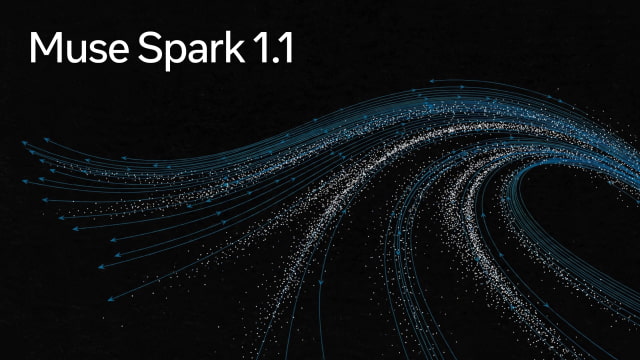
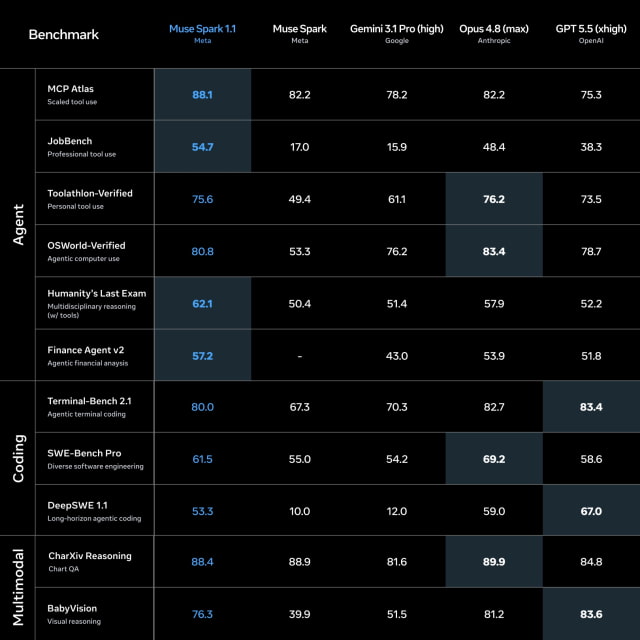
Meta has released an updated version of its artificial intelligence model, launching Muse Spark 1.1 with significant improvements for coding, multimodal reasoning, computer use, and agentic tasks.
The new model builds on the original Muse Spark architecture introduced earlier this spring. Meta says Muse Spark 1.1 completes complex projects significantly faster by orchestrating multi-agent systems to optimize end-to-end latency. It features a one-million-token context window that can retrieve information from much earlier work while compacting older context to preserve important details. The model can also serve as a main agent that delegates work to subagents or operate as a subagent that knows when to escalate tasks back to the primary system.
Muse Spark 1.1 is also designed for computer-use workflows spanning multiple applications. The model determines whether it is faster to automate a task with a script or interact directly with an application's interface, while maintaining context across extended sessions, adapting to changing requirements, and navigating unfamiliar interfaces with minimal human intervention.
Coding performance has also improved substantially on real-world tasks involving large codebases. Meta says the model can diagnose complex bugs, implement new features in enterprise systems, execute large code migrations, and supports common agentic coding workflows such as planning mode, subagent delegation, and context compaction. The release reflects the broader industry push toward agentic development tools, an area Apple recently embraced with the introduction of Xcode 27. Replit CEO Amjad Masad described Muse Spark 1.1 as "a complete agentic foundation," highlighting its million-token context window, multimodal support, coding capabilities, and OpenAI-compatible API.
Alongside its coding improvements, Muse Spark 1.1 expands multimodal reasoning with strengths in visual-to-code generation, highly descriptive image and video captioning, and workflows that combine perception with action. Meta says the model can analyze visual and audio inputs while operating a computer on a user's behalf.
Meta also conducted extensive safety evaluations before deployment under its Advanced AI Scaling Framework. The company says Muse Spark 1.1 operated within safe margins across chemical and biological, cybersecurity, and loss-of-control risk categories, while demonstrating stronger resistance to jailbreaks and prompt injection attacks, lower hallucination rates, and reduced sycophancy.
Developers can now access Muse Spark 1.1 through Meta's new Model API, which launched in public preview alongside the release. The model is also available immediately in "Thinking" mode through the Meta AI app and on the Meta.ai website.






![Apple Watch Series 12 and Ultra 4 Score 4/10 in iFixit Teardown [Video]](/images/news/102633/102633/102633-160.jpg "Apple Watch Series 12 and Ultra 4 Score 4/10 in iFixit Teardown [Video]")
![How To Force Restart iPhone [Video]](/images/tutorials/95012/95012/95012-160.jpg "How To Force Restart iPhone [Video]")
![How To Turn Off iPhone [Video]](/images/tutorials/94999/94999/94999-160.jpg "How To Turn Off iPhone [Video]")
![How To Back Up Your iPhone to an External Drive on Mac [Video]](/images/tutorials/72786/72786/72786-160.jpg "How To Back Up Your iPhone to an External Drive on Mac [Video]")


![Mac mini Drops to $779.99 for Prime Big Deal Days [Deal]](/images/news/102624/102624/102624-160.jpg "Mac mini Drops to $779.99 for Prime Big Deal Days [Deal]")